- The challenge
Document workflows needed structure, not more storage
Contracts, filings, approvals and correspondence need more than a folder. They need a place where a document has an owner, a case, a version and a history — and where the right people can reach it and the wrong ones cannot.
- The solution
A modular ERP built around real practice
Every part of Obligano is a module. A small practice switches on cases and clients; a larger one adds the client portal, finance and document workflows. The system grows without a migration project each time.
- The impact
More visibility, far less manual coordination
Case status, revenue and recent activity are on one dashboard instead of being reconstructed. Sensitive documents move through a controlled channel rather than an email thread.
Modular ERP · SaaSSkyway Horizon · own product · 2026
A modular ERP, shaped to the practice that uses it
Obligano is our own ERP platform, built first for law firms and other practices whose work is cases, documents and deadlines. You start with the modules you need — cases, client communication, the client portal, finance — and switch on the rest when the practice grows into them.

- Role
- Product, design, engineering
- Type
- Own SaaS product
- Built for
- Law firms & advisory practices
- Status
- Open beta v1.0
A secure workspace for document-heavy practice
A law firm runs on cases, documents, correspondence and deadlines. Most of it ends up spread across a file server, a mailbox and somebody's spreadsheet — which works until a document has to be found, a deadline has to be proven, or a colleague has to take over a case.
Obligano brings cases, client records, documents, client communication and finance into one modular system, with clear permissions and a record of what happened when.
Inside the product
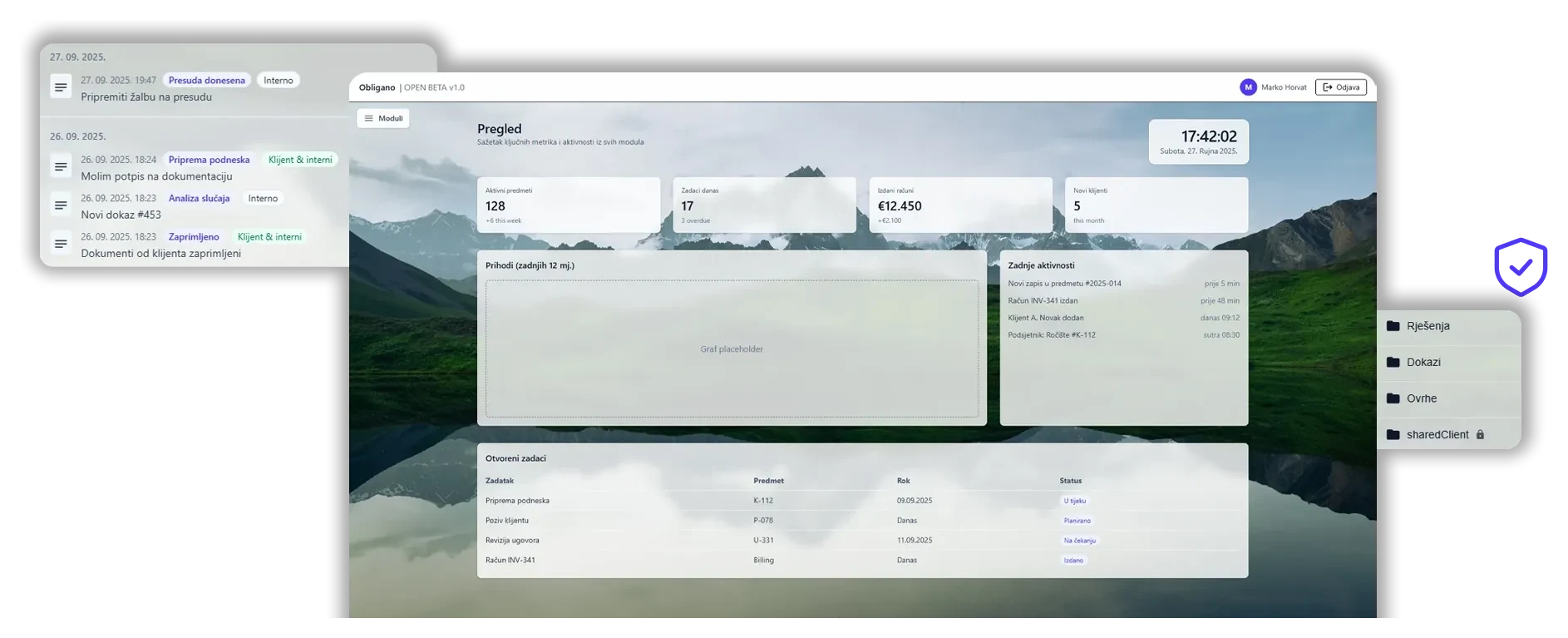
01The workspace
A case, its history and its documents in one place
Every matter keeps its own timeline. Each entry is dated, labelled with the phase it belongs to — case analysis, drafting a filing, judgment delivered — and marked as internal or shared with the client, so anyone who picks up the case can see exactly what happened and when.
Documents live in the case's own folders — decisions, evidence, enforcement — and a separate shared folder is the only one the client can see.
- A dated timeline for every case
- Internal notes kept apart from what the client sees
- Folders per case, with permissions built in
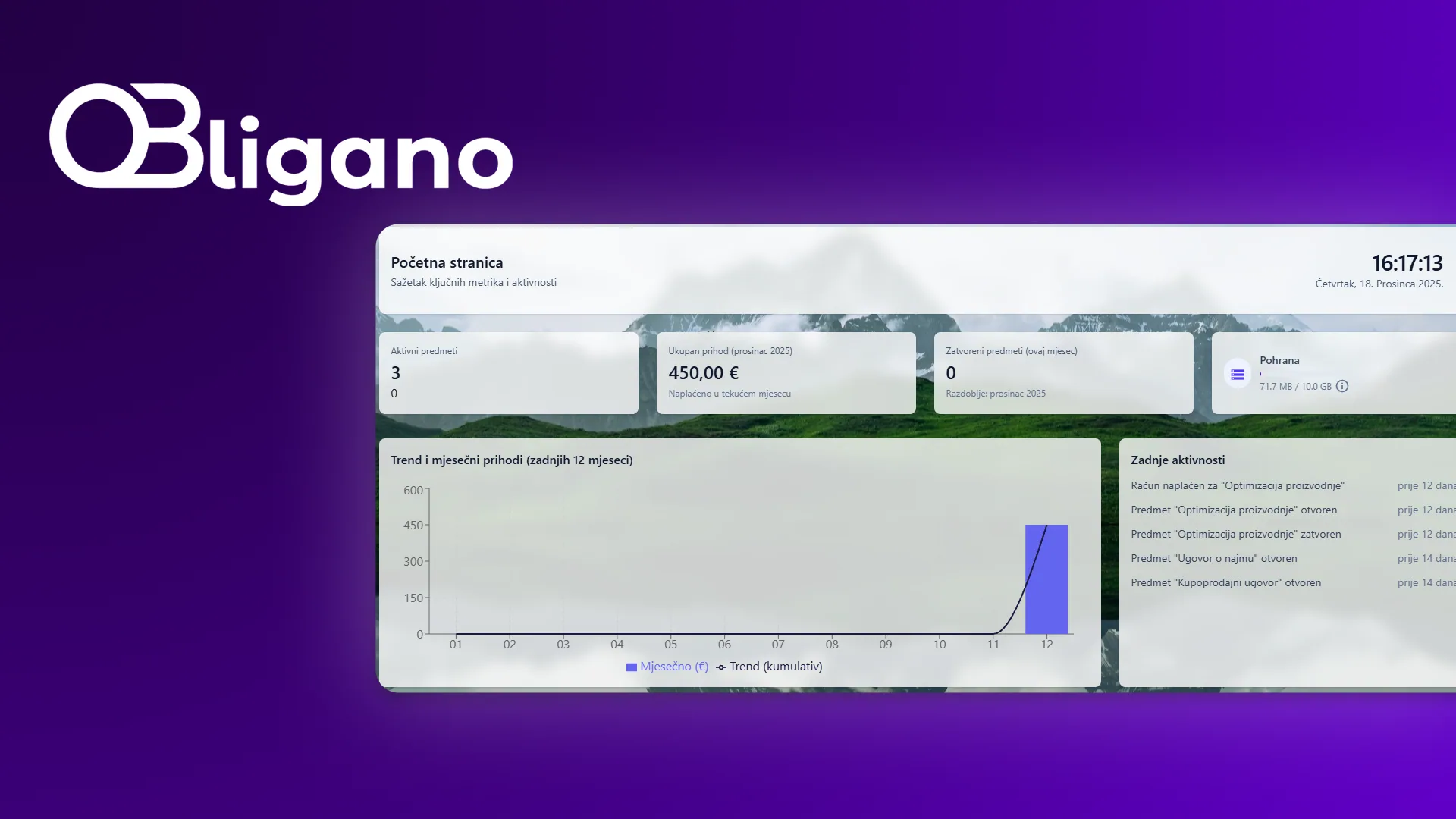
02The dashboard
The state of the practice, without building a report
The home screen is a summary of the whole firm: active cases, revenue collected this month, cases closed and how much document storage is in use.
Revenue is drawn over the last twelve months, and the activity feed shows what was opened, closed and invoiced — because finance and cases live on the same record, the picture assembles itself as the work gets done.
What we built
- 01Cases followed through their phasesEvery matter moves through defined stages, with its documents, notes and correspondence attached to it rather than scattered around it.
- 02A client portal for secure exchangeClients receive and send documents through a controlled channel with permissions and traceability, instead of unencrypted attachments.
- 03Finance on the same recordInvoices and revenue sit against the case they came from, so the monthly picture builds itself as the work happens.
- 04Modules you switch on when you need themDashboard, cases, communication, client portal, client database and finance are separate modules — start with a few, add the rest later.
A foundation that scales with the firm
Obligano gives a practice one reliable place for its cases, documents and money, with permissions and history built in. It is in open beta and shaped by the firms using it.
The same work, as a service
- Document managementFiles and documents are everywhere: in email, on a shared drive, on someone’s laptop. We build the single place they belong, with the access rules your business actually needs.Learn more
- Business softwareYou shouldn’t need two days and three spreadsheets to answer “how are we doing this week?”. We build the system that answers it as the work happens.Learn more
- Custom software developmentOff-the-shelf software asks you to adapt your process to it. We do the opposite: we understand how your company works, then build the system around that.Learn more
Tell us what your team is doing by hand today.